KR4CYF

Ham Radio Journey

By the end of summer I was ready to decide on a first HF transceiver. Looking for SSB and digital modes and the possibility of portable/battery operation, but at the lower end of the possible budget for such things, I'd narrowed my search to either the QRPLabs QMX+ or HFSignals sBitx. Being a long-time linux user, the sBitx ultimately won me over for the 25W transmit power and active open source community and having a “full” computer (Raspberry Pi 4) tucked inside.

I ordered just as tariffs and global shipping went haywire in August, with their shipper DHL pausing all shipments to the US. But a month later it arrived suddenly, and like that I was on the air.
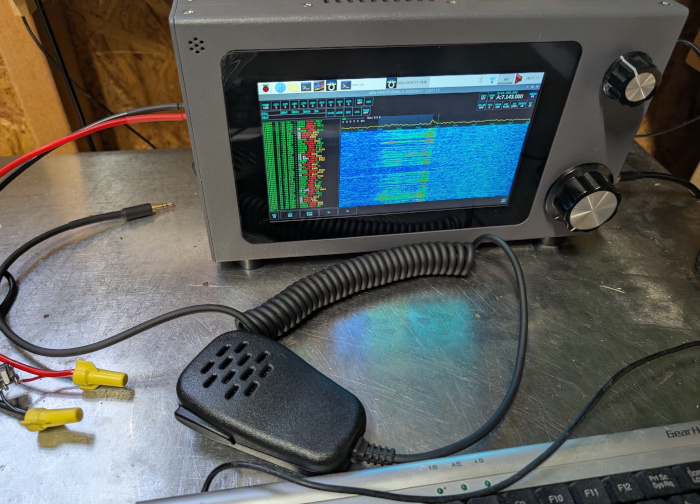
sBitx on workbench

My antennas turned out mostly reasonable for TX, with SWR below 1.6 on 20m and 80m, and 1.2 on 40m at 6-12W as reported on the sBitx. Once I get to testing them with a NanoVNA I'll have more confidence in driving a bit more power, but I've been quite happy with the QRP-esque experience of making global contacts on a little power.

I soon swapped the firmware for the 64bit community release for a few niceties in the remote web interface (which I don't actually use much), and got it minimally setup with rigctl to sync radio information with my self-hosted Cloudlog instance. And after waiting on a postcard from the ARRL, I was able to link these to LOTW. Convenient to do this all on the radio-with-a-web-browser.

As anticipated from forum discussions, the included PTT microphone is really pitiful and I was initially unable to make any successful SSB contacts. But I fell in love with the built-in FT8 mode of the sBitx interface, and have made most of my QSOs that way this year. Late in the year I replaced the microphone element and was able to join a random net (OMISS ) on 20m to confirm it was working. But POTA pileups on SSB continue to intimidate hanging on to be heard.

The DX experience with FT8 has continued to be a joy, in 2025 I made 57 QSOs (40 confirmed QSLs by LOTW), a couple every week or two this fall, including to Italy, Greece, Belgium, France, Dominican Republic, and Cuba on 80m, 40m, 20m, and 15m. A good start!
With a fresh Ham Radio license on my wall alongside a printout of the US Amateur Radio Bands, and the woodshop shed likely to become my ham shack, I now had plenty of time to consider what antenna to erect at home.

Constraints

I moved my temporary dipole (roughly cut for the 20m band) to the side of the shed and continued listening in, but knew I would want coverage for a number of the HF bands and that I needed to get higher off the ground in order to usefully transmit – received wisdom is that below a half-wavelength becomes less useful for distance communication due to the angle of radiation, and for how much power is absorbed by the ground. But thankfully all the math and models somewhat wash out against the reality of hanging things from trees and roofs, knowing I was not constructing a huge mast, I would be able to get between 8-15m up in the air, and that would dictate whether the 80m or 10m bands were primarily usable for me for near or far communication. I paced off distances between all the clear paths to trees that intersected my shed, which also gave me some length constraints, though good options for dipoles for 20m, 40m, perhaps 80m.

Fan Dipole

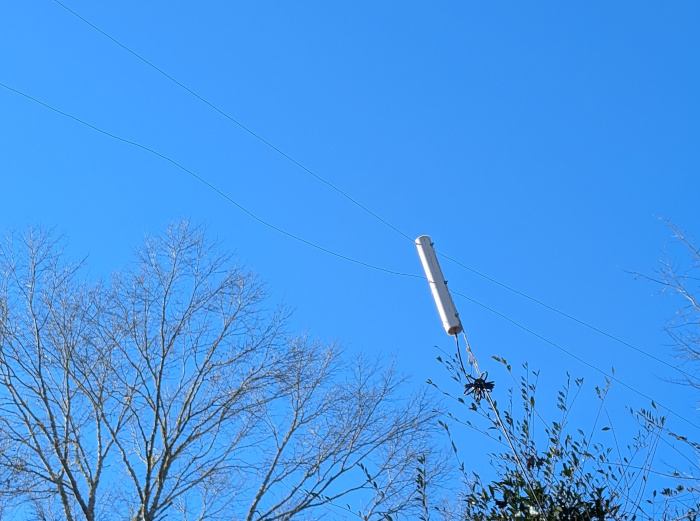
So many acronymns and names were thrown my way for multi-band antenna designs – G5RV, EFHW, Zep, Fan Dipole. Without a transceiver or other peripheral testing equipment to evaluate and the ease of 50-ohm impedance, I decided to start with an expansion of my wire dipole to a fan dipole for both 40m (and hopefully 15m) and 20m based on this design which gave good confidence for spacing the wires and connections. After a few days getting a crude pulley mounted in opposing trees and constructing the central PVC support and coax terminations, I was once again rewarded with “works on the first time” listening in to contacts on new wavelengths and further afield – now more often I might even hear both sides of a conversation! Perhaps irrelevantly I also added a 1:1 choke balun to the coax feedline based on this page, 12T on FT-240-43.

40-20m fan dipole center

End-fed Half-Wire

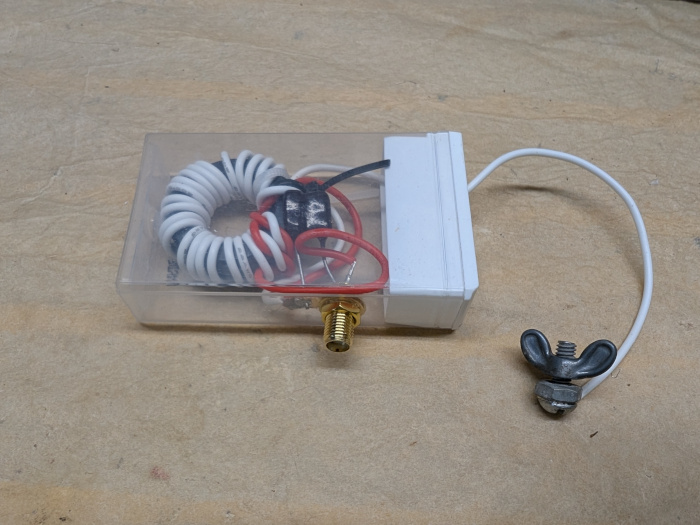
In keeping to exploring cheap self-built options, and wanting to try portable operation in the future, I'd be likely to use an EFHW tossed up temporarily in a tree. To experiment with this, I'd ordered the basic parts for a low-wattage 49:1 unun (toroid, capacitor) along with the coax connectors I needed for the dipole. Some winding of wire and point-to-point soldering and it all fit in a tic-tac container. So next I threw another line up in a further tree and lifted a 137ft length of wire to an inverted vee (about 12m at the high point, 3m at either end) kinda perpendicular to the fan dipole. This antenna added 80m to my listening, and was reasonably effective on 40m and 20m as well for some comparison between the two antennas.

EFHW toroid in a tic-tac container

Time to decide on a real radio next!

Pushed by a few friends joy with electronics and tales of portable radio fun in parks for POTA, and with Hurricane Helene's aftermath a reminder of its role in disaster communication, I decided a new hobby was just what I needed.

I began studying for the license exam on HamStudy along with a few library books. The immediate (and ongoing) reaction was nostalgia. As a kid I had dabbled with small electronics projects and remember browsing the library stacks into Amateur Radio books, at the time the math of frequencies and antennas, the intimidating Morse Code requirement, and the expense of equipment led to other computer interests. But memories of listening in to shortwave broadcasts and the now-familiar simple circuitry and physics questions of the exam reconfirmed all that early interest.

On the advice of ham friends I studied for both the Technician and General licenses at the same time, as getting on HF bands is my main interest. Waiting to decide on equipment I started with an RTL-SDR USB receiver and soon strung up a dipole antenna in the backyard – two lengths of fence wire at clothesline height and alligator clips to the receiver's coax, and the gleeful immediate reward of hearing contacts across the East coast. A positive confirmation of the basic fundamentals and unintermediated possibilities for communication in an era of my increasing disatisfaction with the internet.

I tentatively attended our local small Amateur Radio Club's monthly meeting in February, which pushed me to get my callsign as soon as I felt reasonably solid in my practice tests. I opted for a virtual testing session with a very helpful set of volunteers, and in early April 2025 I became a General-licensed ham operator. Now I would need to get serious about what antenna and transceiver would actually get me on the air.